


Mr. Abdul Qadir
The Architect of Pakistan’s Financial Dawn
Second Governor, State Bank of Pakistan
(July 20, 1953 – July 19, 1960)
In the pantheon of Pakistan’s founding financial luminaries, few figures cast as long a shadow as Mr. Abdul Qadir—a man whose quiet brilliance and unwavering dedication helped shepherd a nascent nation through the uncharted waters of economic sovereignty. His story is one of transformation: from the dusty lanes of colonial Punjab to the marble corridors of monetary power, where destiny and duty converged to forge the bedrock of Pakistan’s financial architecture.
The Forging of a Financial Visionary
Born in1903 in Jalandhar, a bustling commercial hub of British Punjab where the rhythms of trade and commerce would first whisper their secrets to the ears of young Abdul Qadir. His formative years unfolded against the backdrop of a subcontinent stirring with dreams of independence.
The hallowed halls of Forman Christian College in Lahore became the crucible where his intellectual mettle was tempered. This venerable institution, renowned for nurturing some of the subcontinent’s finest minds, instilled in him not merely academic rigor but a profound appreciation for public service—a calling that would define the very essence of his professional odyssey.
The Colonial Apprenticeship: Building the Foundation
Like many of his generation who would later become Pakistan’s institutional pillars, Mr. Abdul Qadir began his career in the labyrinthine corridors of British administrative machinery, joining the prestigious Indian Audit and Accounts Service. For six formative years, he traversed the administrative heartland of the Raj, from the imperial grandeur of New Delhi to the commercial bustle of Calcutta and the strategic importance of Nagpur, each posting adding layers to his understanding of sub-continental finance.
The year 1936 marked a pivotal moment in his ascent when he was transferred to the Finance Ministry of the Government of India and selected for the elite Finance and Commerce Cadre, a recognition of his exceptional capabilities and future promise. As Income Tax Commissioner for Punjab, Delhi, and the North-West Frontier Province, he wielded considerable influence over revenue operations across some of the most economically vital regions of British India, gaining invaluable insights into the fiscal sinews that bound the subcontinent together.
The Great Migration: Choosing Pakistan’s Future
When the midnight hour of August 14, 1947 struck and Pakistan emerged as a sovereign nation, Mr. Abdul Qadir stood among those prescient civil servants who chose to cast their lot with the new Islamic republic. This decision, while personally transformative, carried profound implications for Pakistan’s institutional development, bringing to the fledgling nation a wealth of administrative experience precisely when it was most desperately needed. 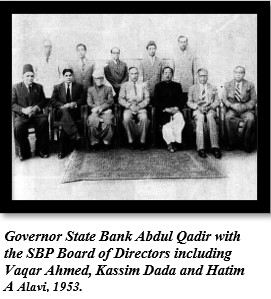
His appointment as Joint Secretary in the Ministry of Finance marked the beginning of his direct contribution to Pakistan’s fiscal foundation. In those crucial early years, when the very survival of the new state hung in the balance, men like him worked tirelessly to establish the fundamental frameworks upon which a modern economy could flourish.
The rapid recognition of his capabilities led to his elevation as Chairman of the Central Board of Revenue, where he played a pivotal role in shaping Pakistan’s taxation policies during its most vulnerable period. Yet perhaps his most historically significant achievement came on February 2, 1950, when he became the first Pakistani to hold the office of Secretary, Ministry of Finance, succeeding Sir Victor Turner—a symbolic and substantive milestone in Pakistan’s journey towards complete administrative indigenization.
The Governorship: Sculpting the Central Banking Legacy
On July 20, 1953, destiny called upon Mr. Abdul Qadir to assume the mantle of Governor of the State Bank of Pakistan, succeeding the pioneering Mr. Zahid Hussain. His tenure, spanning seven transformative years until 1960, coincided with one of the most critical periods in Pakistan’s economic evolution, a time when the young nation was transitioning from the inherited colonial financial structures to a truly sovereign monetary system.
The Institutional Alchemist
Mr. Abdul Qadir approached his responsibilities with the methodical precision of a master craftsman and the visionary outlook of a nation-builder. Understanding that Pakistan’s economic future depended not merely on policy prescriptions but on the strength of its institutions, he embarked upon a comprehensive programme of organizational transformation.
His institutional reforms were both far-reaching and enduring. He restructured the State Bank’s internal architecture, creating specialized departments that could respond effectively to Pakistan’s unique economic challenges. Recognizing that the bank’s influence must extend beyond Karachi’s financial district, he expanded its regional presence, establishing branches that could serve as conduits of monetary policy across the length and breadth of the nation.
Perhaps most significantly, Mr. Abdul Qadir initiated comprehensive training programmes designed to cultivate a generation of indigenous banking professionals. Understanding that Pakistan’s long-term financial independence required not just sound policies but skilled practitioners, he invested heavily in human capital development—a decision whose dividends would be realized for decades to come.
The Regulatory Renaissance
Under the stewardship of Mr. Abdul Qadir, the State Bank evolved from a post-colonial institution into a sophisticated regulatory authority capable of guiding Pakistan’s monetary policy with precision and foresight.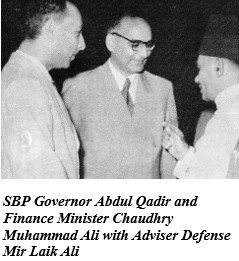
He implemented comprehensive banking regulations that provided both stability and flexibility, creating a framework within which Pakistan’s financial sector could grow while maintaining prudential standards.
His monetary policy approach reflected a deep understanding of Pakistan’s economic realities.Faced with the persistent threat of inflation that plagued many newly independent nations, he crafted policies that maintained price stability without stifling the growth essential for a developing economy. This delicate balance between monetary restraint and economic expansion became a hallmark of his philosophy.
Champion of Indigenous Banking
One of his most far-sighted initiatives was his active support for the development of indigenous banking institutions. Understanding that true economic sovereignty required Pakistani ownership of financial resources, he facilitated the growth of local banks while ensuring they met international standards of operation.
This policy not only diversified Pakistan’s financial landscape but also ensured that the benefits of economic growth would increasingly accrue to Pakistani citizens and institutions. 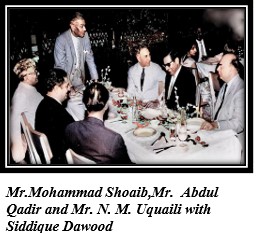
His vision extended beyond urban financial centers to encompass Pakistan’s vast rural population. Under his leadership, the State Bank pioneered initiatives to extend banking services to agricultural communities, recognizing that Pakistan’s economic future was inextricably linked to the prosperity of its farming majority.
The International Statesman
While building Pakistan’s domestic financial architecture, Mr. Abdul Qadir also served as the nation’s financial ambassador to the world, traveling to international conferences and representing Pakistan in global economic forums. His participation in the International Monetary Fund Annual Meetings and other international gatherings helped establish Pakistan’s credibility in global financial circles.
These international engagements were not mere ceremonial exercises but strategic investments in Pakistan’s global economic integration. Through his diplomatic efforts, he helped secure Pakistan’s position in international financial institutions and established relationships that would prove invaluable for the country’s economic development.
The date of Mr. Abdul Qadir’s passing remains unrecorded in available historical sources—a poignant reminder that even the most consequential public servants often fade from public memory while their institutional legacies endure. Yet his contributions to Pakistan’s financial infrastructure continue to resonate through the corridors of the State Bank and the broader Pakistani banking system.
Legacy
In the annals of Pakistan’s institutional history, Mr. Abdul Qadir stands as a testament to the transformative power of dedicated public service. His seven-year stewardship of the State Bank coincided with—and indeed helped enable—Pakistan’s emergence as a viable economic entity. He was instrumental in nurturing Pakistan’s first generation of central bankers—professionals who would carry forward his vision of sound monetary management and institutional excellence. The training programmes he established, the regulatory frameworks he created, and the professional standards he instituted became the foundation upon which subsequent generations of Pakistani financial leaders built.
Perhaps most importantly, Mr. Abdul Qadir’s tenure demonstrated that effective central banking required not just technical expertise but also a deep understanding of national character and aspirations. His ability to balance international best practices with Pakistan’s unique circumstances established a template for indigenous institutional development that extended far beyond the financial sector.
In later years, the State Bank sought to honor Abdul Qadir's legacy through an act that transcended mere remembrance—establishing in 2001 a Memorial Chair in Economics at the University of the Punjab bearing his name. This deliberate bridge between the corridors of policy and the halls of learning became more than commemoration; it transformed his legacy from historical artifact into living dialogue. Here, his vision continues to pulse through scholarly discourse, inspiring new generations to wrestle with the same enduring questions of fiscal prudence, national growth, and ethical stewardship that defined his life’s work—ensuring that his true monument resides not in stone, but in the restless minds of those who carry forward his quest for economic wisdom.
Mr. Abdul Qadir’s legacy transcended policy achievements. His vision of national renewal was never confined to the polished corridors of monetary authority; it flowed outward into the wider currents of civil society. As a Trustee of The Dawood Foundation, he gave tangible form to this conviction, channeling his energies into education and healthcare — the true reservoirs of a nation’s strength. He understood that prosperity is hollow without enlightenment, and that the health of a people is the first condition of their progress. In uniting financial stewardship with social uplift, he revealed a patriotism both practical and profound: one that sought not only to balance ledgers, but to elevate lives. In cultivating human capital with such breadth of purpose, he secured an enduring legacy — his influence living on in the minds he awakened, the futures he fostered, and the countless lives quietly transformed by his philanthropy.
Thus stands Mr. Abdul Qadir’s ultimate legacy: not as a name etched in marble or bronze, but as a living philosophy embedded in the very consciousness of Pakistan’s financial evolution. In every prudent policy decision, every ethical stand taken by a central banker, every moment when institutional integrity triumphs over political expedience, his spirit finds renewed expression. He achieved the rarest form of immortality—becoming not a person remembered, but a principle lived, not a historical footnote, but a perpetual presence in the ongoing story of a nation’s economic soul.
References:
Abdul Qadir (banker). (n.d.). In Wikipedia. Retrieved September 9, 2021, from https://en.wikipedia.org/wiki/Abdul_Qadir_(banker)
International Monetary Fund. (2013). Pakistan: Staff report for the 2013 Article IV consultation and request for an extended arrangement under the extended fund facility (IMF Country Report No. 13/287). https://www.elibrary.imf.org/downloadpdf/display/book/9781475581751/9781475581751.pdf
Malik, F. (2019, May 15). Governors of State Bank of Pakistan. The Nation. https://nation.com.pk/2019/05/15/governors-of-state-bank-of-pakistan/
SBP to set up chairs in five varsities. (2001, December 11). Dawn. https://beta.dawn.com/news/10139
State Bank of Pakistan. (2012, July 5). Past governors. [Archived]. Retrieved September 9, 2021, from https://www.sbp.org.pk/about/governors/past.asp
State Bank of Pakistan Museum & Art Gallery. (2020, December 2). Profile of Abdul Qadir (term from July 20, 1953 to July 19, 1960) [Archived January 8, 2021]. Retrieved September 9, 2021, from https://www.sbp.org.pk/museum/Abdul-Qadir.htm
State Bank of Pakistan. (n.d.). Evolution, Functions & Organization [PDF]. Retrieved from https://www.sbp.org.pk/about/sbp_efo.pdf
TDF Ghar. (n.d.). Abdul Qadir was the second Governor of State… [Facebook page]. Retrieved from https://www.facebook.com/TDFGhar/posts/abdul-qadir-second-governor-sbp