
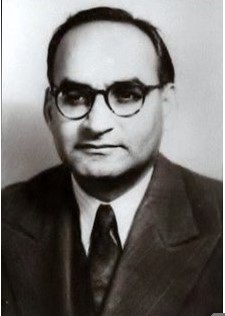
CHAUDHRY MUHAMMAD ALI
1905 – 1980
The Founder of Pakistan’s Constitutional Identity
Fourth Prime Minister of Pakistan (11 August 1955 – 12 September 1956)
The Silent Sculptor of Pakistan’s Destiny:
Among the rarest minds in history are those who choose the foundry over the forum — who measure their worth not in applause but in what endures long after the applause has died. Mr. Chaudhry Muhammad Ali (1905–1980) was such a mind: a statesman who understood that the most consequential act of leadership is not to dazzle a nation, but to build one. When the euphoria of independence had quieted and the hard question emerged not whether Pakistan would exist, but whether it would last it was Mr. Muhammad Ali who answered. Not with rhetoric, but with architecture. If others kindled the flame of Pakistan’s creation, it was Mr. Chaudhry Muhammad Ali who forged the vessel capable of holding it.
Like a chrysalis suspended between fragility and flight, the young state of Pakistan trembled in its earliest years—alive, yet unformed; sovereign in name, yet searching for structure. It was within this delicate interregnum that Mr. Muhammad Ali labored. Under his stewardship, the nation shed its provisional skin and unfolded into the Islamic Republic of Pakistan.
Alchemy of Intellect
In the vibrant city of Jalandhar, Punjab, on 15 July 1905, into an Arain Punjabi family, destiny inscribed the opening verse of an extraordinary life. The young Muhammad Ali possessed that rarest amalgamation of gifts: the exacting precision of the scientist fused with the discerning wisdom of the statesman, the disciplined rigor of the scholar harmonized with the practical insight of the administrator.
After his matriculation, Mr. Muhammad Ali showed great aptitude for science, first moving to attend the Punjab University in Lahore where he read for and graduated with a BSc degree in Chemistry in 1925. The laboratories became his first temple of learning, where he learned that transformation obeys laws, balance is essential, and reactions—if uncontrolled—can be destructive. These lessons would later find expression not in test tubes, but in constitutions. He continued his scientific pilgrimage, ascending to even greater heights of academic achievement, obtaining his Master of Science in Chemistry in 1927—credentials that testified to a mind capable of penetrating nature’s deepest mysteries.
Before the great wheel of history summoned him to grander purposes, he taught chemistry at Islamia College until 1928. There, amid chalk and equations, he planted intellectual seeds—unaware that his own life would soon undergo a far greater metamorphosis. The chemistry of elements would yield to the far more delicate chemistry of nations.
The Ascension Through Empires
The year 1928 marked his entrance into the Indian Audit and Accounts Service, the elite financial spine of the British Raj. He began as an accountant and was soon sent to audit Bahawalpur—a princely state engineered by empire into an exacting administrative organism, its steel nerves carrying the weight of British India. There, Mr. Muhammad Ali entered the inner sanctum of public finance, where numbers spoke, and responsibility acquired the gravity of faith.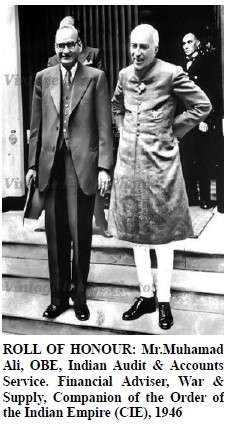
In 1936, Mr. Muhammad Ali was moved as Private Secretary to James Grigg, the Finance Minister of India—a position that placed him at the very nerve center of imperial finance, privy to the most confidential deliberations, witness to the innermost workings of colonial economic policy. For nearly a decade, he served at this elevated station, absorbing wisdom, and accumulating experience that would shape the subcontinent’s destiny.
In 1945, history finally took notice when Grigg appointed him the first Indian Financial Adviser to the War Secretary—an appointment without precedent in British India’s imperial order. The ceiling did not crack; it collapsed. Honoured with the O.B.E. after service at the Middle Eastern war front and later the C.I.E. following the Haidry Mission to England, he wore distinction lightly, never mistaking imperial honours for the measure of his calling. These were not mere decorations, but portents—signs that old hierarchies were yielding, and that the Raj itself was nearing its end.
At Partition’s Precipice: The Dividing of Worlds
As the subcontinent approached its violent sundering, Mr. Chaudhry Muhammad Ali stood at the eye of history’s storm. In 1946–47, he served as one of two secretaries to the Partition Council under Lord Mountbatten, charged with an almost unthinkable task: dividing lands, peoples, assets, armies, and administrations into two sovereign states. Representing Pakistan alongside India’s H. M. Patel, he co-authored The Administrative Consequences of Partition—a document whose quiet title conceals its civilizational gravity.
This was no mere exercise in paperwork; it was the recalibration of a single gravitational field into two sovereign orbits, each requiring mass, momentum, and balance to remain stable. While communal violence surged across the land, while politicians negotiated and armies stood ready, while millions were driven from ancestral homes in the largest migration the world has known, Mr. Muhammad Ali and his counterparts labored in the quieter realms of administration to ensure that the engines of governance continued to turn— that the newly born states would not gasp for breath, but inhale governance, order, and continuity from their very first moment of existence.
At the Hour of First Breath
At Partition, Mr. Muhammad Ali chose Pakistan not for convenience, but for destiny. In August 1947, he became its first Secretary-General, the highest civil office in a state born with little more than resolve. While independence was marked by speeches and celebration, he set about building the nation’s unseen architecture. With no bureaucracy, no precedent, and only urgency to guide him, he worked alongside Mr. Quaid-i-Azam Muhammad Ali Jinnah and Mr. Liaquat Ali Khan to impose order upon fragility. As Finance Secretary in the country’s precarious early years, he helped frame Pakistan’s first federal budget, steadying a state many believed would not survive.
These were not glamorous tasks. History reserves its laurels for those who deliver stirring speeches, who lead charges into battle, who negotiate treaties beneath crystal chandeliers. But nations are not built by speeches alone; they require budgets and bureaucracies, systems and structures, the unglamorous work of administration that transforms aspirations into institutions. Mr. Muhammad Ali understood this truth instinctively.
The Economic Visionary: Laying Foundations in Stone
Appointed Finance Minister in 1951, Mr. Muhammad Ali assumed stewardship of a nation’s fragile economy at its most vulnerable hour. For four decisive years, he governed the exchequer with rare equilibrium—bold yet restrained, visionary yet exacting.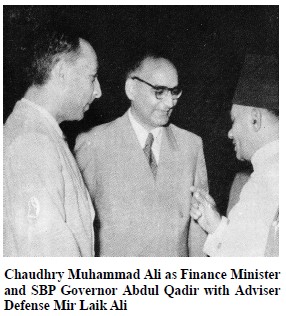
As Finance Minister from October 1951 to August 1955, Mr. Chaudhry Muhammad Ali prioritized fiscal prudence to address Pakistan’s post-partition economic vulnerabilities. The challenges were formidable: a truncated economy still reeling from partition’s trauma, an agricultural base vulnerable to the vagaries of nature and international commodity prices, industrial infrastructure primitive and inadequate, millions of refugees requiring rehabilitation, defense expenditures consuming precious resources as tensions with India simmered.
Yet he did not merely manage these challenges; he transcended them. His policies emphasized revenue enhancement through excise duties and import tariffs while restraining non-essential expenditures, enabling the government to post budgetary surpluses. Mr. Chaudhry Muhammad Ali understood what others could not yet perceive: that a nation without economic planning is a ship without charts. Thus he brought into being the Planning Board—an institutional compass that would evolve into today’s Planning Commission, a body that continues to steer Pakistan’s economic course and shape its development through successive decades.
Even more consequentially, the Pakistan Industrial Development Corporation (PIDC) was founded as a state corporation under Pakistan’s Ministry of Industries and Production in April 1951, beginning operations in 1952. This was revolutionary thinking for its time: a state-led industrial development corporation that would identify strategic sectors, mobilize capital, establish enterprises, and eventually transfer them to private ownership. PIDC became the engine of Pakistan’s industrial renaissance, the institutional mechanism through which a predominantly agricultural economy began its transformation into an industrial power.
In those years as Finance Minister, he was not merely managing finances; he was sculpting the economic clay from which a modern nation would emerge. While politicians debated and orators declaimed, he quietly built the institutional infrastructure that would outlast them all.
The Crown of Constitutional Glory
On 11 August 1955, Mr. Muhammad Ali became Prime Minister of Pakistan, inheriting a nation still without a constitutional compass. Eight years after independence, the young republic faced a vacuum that threatened its very legitimacy. In his first address, he declared with clarity that framing a constitution “which must reflect the finest traditions of Islam” would define his premiership—a sacred covenant rather than a political promise.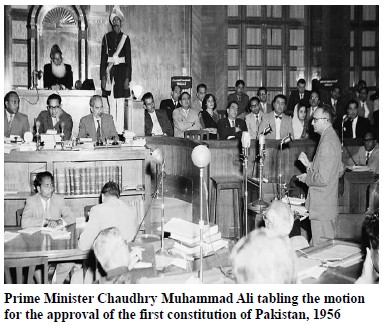
For thirteen months, he navigated the deadlocks of the Constituent Assembly, balancing Islam and democracy, federal authority and provincial rights, and safeguarding minorities while shaping a parliamentary system. Collaborating with opposition parties, he wove together divergent visions into a single framework, producing a consensus document that became the draft constitution introduced on 9 January 1956.
The Constitution, promulgated on 23 March 1956—the anniversary of the Pakistan Resolution—declared Pakistan an Islamic Republic with a unicameral parliament and federal divisions. Every article was a compromise, every clause a careful balance, every provision a synthesis of competing visions. The chrysalis had become a butterfly; the promise had become reality. Through this achievement, Mr. Muhammad Ali gifted Pakistan not merely a legal document, but a covenant between state and citizen, a framework for coexistence, and an enduring instrument through which democratic aspirations could find expression.
The One Unit Synthesis: Controversy and Calculus
To achieve constitutional balance and address the demographic divide between East and West, Mr. Muhammad Ali implemented the One Unit scheme in October 1955, merging West Pakistan’s four provinces into a single administrative entity. The logic was clear: equal representation in the federation despite unequal populations, ensuring West Pakistan’s voice was not swallowed by the numerical majority of the East.
Yet the scheme provoked fierce opposition. Sindhis, Pathans, and Baloch saw it as an erasure of identity and autonomy; protests and intellectual dissent reflected fears of Punjabi domination. While it temporarily streamlined administration and enabled the 1956 Constitution, its centralization sowed lasting grievances and would be abolished in 1970—proof that unity imposed by decree cannot substitute for consent.
Even so, Mr. Muhammad Ali’s intent was preservation, not coercion. He sought to secure national cohesion and create the conditions for constitutional order. Noble in purpose, his decision was an act of governance weighed against history’s impossible pressures, a testament to the dilemmas inherent in forging a new nation.
The Diplomat’s Olive Branch: Kashmir and Regional Peace
Governance consumed him, yet it never confined him. In July 1956, Chaudhry Muhammad Ali stepped beyond the blueprints of nation-building and into the more treacherous terrain of reconciliation — travelling to meet Jawaharlal Nehru across the wound that partition had left open between two peoples who had once been one.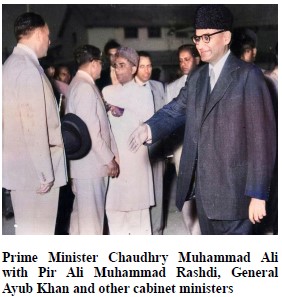
Kashmir hung between them like an unfinished sentence — heavy with memory, resistant to resolution. Yet Muhammad Ali came not to win an argument but to begin a conversation, understanding what too few statesmen ever grasp: that a nation's true security is not garrisoned in its armies alone, but in the quality of its silences with its neighbours.
The meeting yielded no treaty, signed no peace. But it offered something rarer — proof that leadership, at its most luminous, is the willingness to extend a hand across a scarred frontier before the scar has healed.
Prime Minister Chaudhry Muhammad Ali with Pir Ali Muhammad Rashdi, General Ayub Khan and other cabinet ministers.
The Tempest of Political Fortune: The Price of Principle
But politics is a wilderness that devours its finest navigators. Mr. Chaudhry Muhammad Ali — a man built for permanence in an arena that rewards only the expedient — was never truly at home in its treacherous currents. He had forged a constitution; he could not forge allegiances from ambition and envy. His coalition was not a partnership of vision but a confederation of competing hungers held together by necessity alone. When necessity passed, so did their loyalty.
The forces that undid him were as old as power itself — faction, jealousy, the quiet fury of men who felt diminished by his stature. Party bosses bridled at his principles. Regional leaders chafed against One Unit. Rivals circled, patient and predatory, waiting for the moment his integrity left him exposed.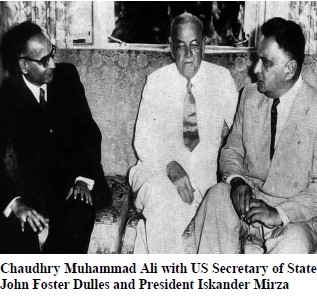
It came on 8 September 1956. A no-confidence motion — orchestrated, clinical, inevitable — stripped him of party leadership. Four days later, he resigned the premiership. He left as he had governed: without theatre, without bitterness, his dignity so complete it bordered on reproach.
He was not defeated. He was simply too rare for the room.
The Elder Statesman and Democracy’s Guardian
Where lesser men might have retreated into bitterness, nursed grievances, or scrawled vitriol against those who betrayed them, Mr. Chaudhry Muhammad Ali chose a higher path. After his resignation, he turned his formidable intellect to the National Bank, guiding the nation’s financial destiny from the shadows of power, proving that true influence does not always wear the crown of office. He remained engaged, relevant, and steadfast.
When Ayub Khan’s iron hand descended in 1958, extinguishing the democratic lights he had helped ignite and abrogating the Constitution he had painstakingly crafted, he emerged once more—not from marble halls or ministerial podiums, but into the streets, the assemblies, and the gatherings of ordinary citizens. Ostracized by the political establishment that had once sought his counsel, dismissed as inconvenient, he pressed on undeterred, for he understood what fleeting ambition often forgets:
That the Constitution is more than law—it is a covenant; that democracy is more than governance—it is a sacred trust; that institutions endure where men falter; and that principles, once embraced, outlast the ephemeral glories of power.
The Scholar’s Testament: History’s Witness Speaks
Mr. Chaudhry Muhammad Ali’s primary scholarly contribution was The Emergence of Pakistan, published in 1967 by Columbia University Press. The 418-page volume offers a firsthand account of the political and administrative events from 1946 to 1948, centered on the partition of British India and the establishment of Pakistan.
It emphasizes the strategic decisions of the All-India Muslim League, including Mr. Muhammad Ali Jinnah’s leadership, and critiques delays in British policy as causal factors in communal violence and refugee crises during the transition.
The book stands today as one of the most authoritative accounts of partition’s administrative dimensions and Pakistan’s founding years—a gift to historians and citizens alike, testimony transcribed, and memory transformed into monument.
The Final Sunset
Mr. Muhammad Ali died of cardiac arrest on 2 December 1980 at his residence in Karachi, where he was laid to rest. The heart that had beaten for Pakistan’s constitutional birth, for its economic foundations, for its democratic aspirations, for its regional peace, finally stilled. The mind that had drafted budgets and constitutions, that had negotiated with viceroys and prime ministers, that had built institutions and authored histories, finally rested.
He was seventy-seven years old. He had witnessed the twilight of the British Raj and the dawn of independence, the trauma of partition and the joy of constitutional promulgation, the chaos of nation-building and the tragedy of military dictatorship. He had served his nation as bureaucrat and minister, as finance minister and prime minister, as institutional builder and constitutional architect, as democracy’s defender and history’s chronicler.
What followed his passing was not silence but the unmistakable sound of everything he had built continuing to function without him. The Planning Commission, the Constitution, the industries, and the institutions — each one a quiet refusal to let him be forgotten
This is the final measure of a statesman: not the eulogies delivered at his grave, but the work that outlives the eulogies. By that measure, Mr. Chaudhry Muhammad Ali does not merely belong to history.
He is still happening.
The Legacy’s Living Branches: Inheritance of Excellence
Greatness, when it is genuine, does not exhaust itself in a single generation. It flows forward — quietly, purposefully — finding new vessels, new expressions, new arenas of service. So it was with the family of Chaudhry Muhammad Ali.
His elder son, Mr. Khalid Anwer, inherited his father's devotion to constitutional order and carried it into the courtroom. A distinguished lawyer and Minister of Law and Justice under Nawaz Sharif, he stood in the breach during Pakistan's constitutional crises of the 1990s — arguing before the Supreme Court, defending democratic principles with the same quiet ferocity his father had brought to their founding. When he passed in March 2025 at eighty-six, Pakistan lost not merely a lawyer, but a living bridge to its constitutional conscience.
His younger son, Mr. Amjad Ahsan Ali, chose a different frontier — medicine — healing bodies with the same precision and compassion his father had brought to healing a body politic. Different arena, identical devotion. When he departed in August 2023, that devotion passed from the living world into memory, leaving behind the quiet testimony of a life spent in service to others.
Together, they embodied what their father had always understood: that privilege is not an inheritance to be enjoyed, but a responsibility to be discharged. That talent, without dedication to something larger than itself, is merely ornament.
The Chrysalis Fulfilled
Hence, the trembling chrysalis did not remain suspended forever. Pakistan — born in flame yet uncertain of its frame — did not linger between proclamation and permanence. In the steady hands of Mr. Chaudhry Muhammad Ali, what had once quivered between uncertainty and aspiration gathered form, gathered strength, and at last broke open into flight. The butterfly had emerged. The fragile casing of provisional statehood yielded to the quiet, irresistible force of a mind that refused to let possibility remain merely possible.
The butterfly soars still. Battered by storms its founder could not have anticipated, tested by seasons of democratic winter, yet never wholly grounded — because the wings were built by a man who understood permanence. His name may not ride the wind that carries it. But the wind — the constitutional breath that has kept Pakistan aloft through every turbulence of its existence — is his. In every note this nation plays, in every return to order after the darkness of its abandonment, he is there. Silent beneath the music. The stillness without which the whole composition was always going to collapse into noise.
https://www.youtube.com/watch?v=-s6RL5vVCbQ [Chaudhry Muhammad Ali Biography |
The History of Pakistan, Former Prime Minister]
References:
1. "Chaudhry Muhammad Ali." Wikipedia, The Free Encyclopedia. https://en.wikipedia.org/wiki/Chaudhry_Muhammad_Ali
2. "Chaudhry Mohammad Ali." Encyclopædia Britannica. https://www.britannica.com/biography/Chaudhry-Muhammad-Ali
3. Ali, C. M. (1967). The Emergence of Pakistan. Columbia University Press. https://en.wikipedia.org/wiki/The_Emergence_of_Pakistan
4. "Chaudhary Mohammad Ali." The Nehru Archive. https://nehruarchive.in/people/chaudhary-mohammad-ali
5. "Chaudhary Mohammad Ali (1905-1980)." History Pak. https://historypak.com/chaudhary-mohammad-ali-1905-1980/
6. The Constitution of the Islamic Republic of Pakistan (1956-1958)
7. Wikipedia contributors. "Khalid Anwer." Wikipedia, The Free Encyclopedia. https://en.wikipedia.org/wiki/Khalid_Anwer
8. "Ex-federal minister Khalid Anwer passes away." Dawn. https://www.dawn.com/news/1897766
9. Express News. (2023). Aik ‘aalim jo bemar dilon ka maseeha tha. https://www.express.pk/story/2537556/