
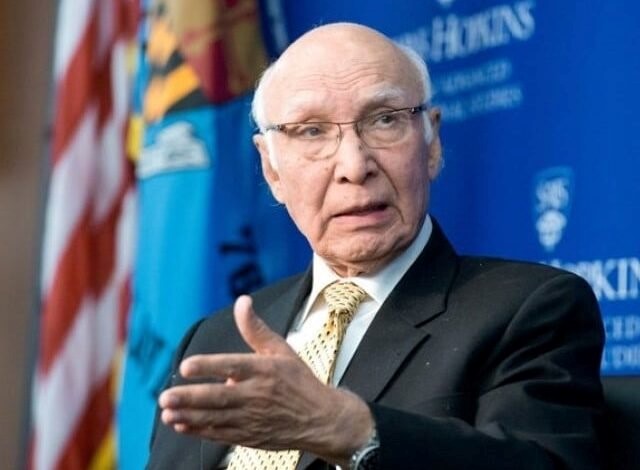
Mr. Sartaj Aziz (1929-2024)
Former Finance Minister
(1990 – 1993 & 1997 – 1998)
Education and Early Life:
Mr. Sartaj Aziz was a highly educated and accomplished economist and strategist, who played a major role in the UN, in government, and in international affairs. He served as a senator, deputy chairman of the Planning Commission of Pakistan, and member of the federal cabinet initially as Minister of State for Agriculture and Food Security, and later as Minister of Finance and Minister of Foreign Affairs, as well as Adviser to the Prime Minister on National Security and Foreign Affairs.
Born on February 7, 1929 in Mardan in a lower middle-class family, Mr. Aziz demonstrated an early inclination towards academics and leadership.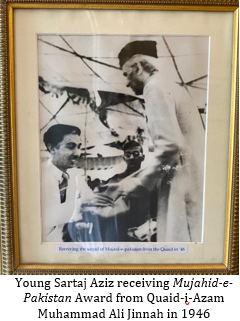 He came from a family with Sufi bent of mind and an inclination for spiritual awareness and consciousness that also accompanied him all his life.
Within three years of joining the Accounts Service in 1951, he was selected for a three-month long course in organization and methods and elementary computer training in the UK. In 1962, he was selected to attend the Kennedy School of Government at Harvard university for a Master’s degree in Development Economics. His education at Harvard allowed him to interact with prominent economists and policymakers, gaining insights into effective policy implementation strategies.
Professional Experience & Achievements:
Mr. Sartaj Aziz was a distinguished statesman, economist, and policymaker whose career spanned over six decades, making significant contributions to Pakistan’s governance, economic planning, and international diplomacy. His vast experience in civil service, international organizations, and politic made him one of pakistan's most respected figure in economics and foreign affairs.
Based on the result of Central Superior Services exams in 1951, Mr. Aziz was allocated to Police Service of Pakistan, but he regretted the offer of appointment unless he was allocated to a service of his choice. Since he was interested in becoming a policy professional with a focus on budget-making and evolving sound commercial and economic policies, he readily accepted when he was offered the Military Accounts Department. For the first six years, he was trained in departmental accounts and served in the Military Accounts Department.
In 1958, he joined as Secretary of the Administrative Reforms Committee (ARC) which had been set up after Ayub Khan martial law, one amongst various commissions and committees meant to reform the system. He was responsible for taking minutes of its numerous meetings and preparing working papers. He worked so well that when on the recommendation of the Committee, Principal Accounting Officers scheme was introduced in the Secretariat with the best officers from CSP, Accounts and Revenue services selected for assisting the PAO as Financial Advisors, Mr. Aziz was one of them. In 1958, he also received Tamgh-e-Khidmat from Ayub Khan for his services to ARC.
On conclusion of the work by ARC, the head of the Committee who was also the Deputy Chairman Planning Commission asked him to join the Commission as Deputy Secretary. He served in the Commission for nearly ten years. The Commission in those days was hub of all economic activities, not only formulating Five-Year plan and Annual Development Plans but most of the budget speeches originated there. Even the Economic Affairs Division was its part for better coordination of foreign exchange allocations for development projects.
Mr. Aziz along with Mahbub ul Haq and Moinuddin Baqai was part of the famous trio and the second line of professional policymakers below the minister and the permanent secretary. His expertise in economic planning allowed him to contribute to several key strategies that shaped Pakistan’s financial and industrial growth during the 1960s.
In 1971, Mr. Sartaj Aziz transitioned to international organizations, beginning with Food and Agriculture Organization (FAO) of the United Nations. As Director of Commodities and Trade Division, he focused on agricultural trade policies, food security programs, and international commodity agreements. His most notable achievement at FAO was organizing the 1974 World Food Conference, which played a significant role in addressing global food security concerns. This event led to the establishment of various international frameworks for food distribution, sustainable agriculture, and hunger alleviation programs. He was the innovator, thought leader and founding force behind creation of International Fund for Agricultural Development (IFAD).
His Aziz expertise in global food policy eventually led to his appointment as Assistant President for Policy and Planning at IFAD in 1977, where he worked on rural poverty alleviation policies, financing mechanisms for small-scale farmers, and the development of sustainable agricultural practices. His tenure at IFAD further strengthened his reputation as an expert in international economic development and agricultural finance. In 1975, he became one of the founding members of the Third World Forum which brought together scientists and economists of developing nations to articulate common perspectives of poor countries on global development issues.
After spending over a decade working with international organizations, Mr. Aziz returned to Pakistan in 1984. He was appointed Minister of State for Food and Agriculture. In this role, he implemented major agricultural reforms that focused on enhancing food production, modernizing irrigation systems, and improving rural livelihoods. He also chaired the National Commission on Agricultural Development whose seminal report suggested pathways for sustained agricultural growth for ensuring Pakistan’s food security.
He also contributed to the development of Prime Minister Junejo’s 5-point development program and initiated the Social Action Program. His third and fourth initiatives were National Rural Support Program following on the model of AKRSP, and the establishment of Poverty Alleviation Fund. It took him almost fifteen years to build the “software” constituting the four main pillars of social development in Pakistan – physical infrastructure, social infrastructure, community organizations to organize people, and then micro credit to channel additional resources to community organizations. If you have the “software” along with the money, then it is not wasted, he believed.
Mr. Aziz’s political career gained further momentum when he was elected as a Senator in 1988 and re-elected in 1993. In 1990, he was appointed Minister of Finance at a time when Pakistan faced significant economic challenges. As Finance Minister, he initiated a major program of rapid privatization and deregulation, trying to open up the economy, and moving towards the market system. With staggering speed, he altered the foundations of the Pakistani economy, bulldozing regulations out of the way, and privatizing both the public sector and the banking system.
His first tenure as Finance Minister ended in 1993, but he returned to this position in 1997. Once again, he focused on stabilizing Pakistan’s financial sector, reducing fiscal deficits, and implementing IMF-led economic reforms to ensure macroeconomic stability.
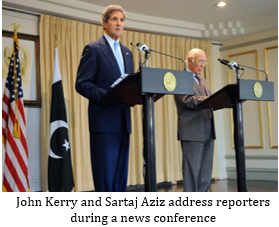
After a brief period away from active politics, Mr. Aziz re-entered the government in 2013 as Adviser to the Prime Minister on National Security and Foreign Affairs. This role made him one of the most influential policymakers in Pakistan’s foreign relations. As an adviser, he played a key role in shaping Pakistan’s diplomatic strategies, particularly in strengthening relations with China, managing tensions with India, and expanding economic and trade cooperation through the China-Pakistan Economic Corridor.
A notable feature of Sartaj Aziz’s public life was his ability, as head of national commissions/committees, to resolve some of the most intractable national issues, such as the accord on the apportionment of the Indus Basin waters (1991) – a consensus document on a highly contentious issue in inter-provincial relations; a contingency plan for food security (2008); reforms in former FATA and their integration into Khyber Pakhtunkhwa (2016); political reforms in Gilgit-Baltistan – recommending “provisional provincial” status to provide constitutional rights to its people without affecting Pakistan’s position on the Kashmir dispute (2017) and, last but not least, the National Water Policy (2018) – a comprehensive blueprint for integrated management of water resources, along with a Water Charter signed by the chief ministers of the four provinces. Apart from his government roles, Mr. Sartaj Aziz was a respected academic and author. From 2004 to 2013, he served as the Vice Chancellor of Beaconhouse National University, where he contributed to the promotion of liberal arts education and research.
Legacy and Impact:
Mr. Sartaj Aziz left behind a lasting legacy which is recognized both at the national and international levels. For his contributions to Pakistan’s economic policies, foreign relations, and public service, Mr. Sartaj Aziz received several awards and recognitions. He was honored with Tamgha-e-Pakistan in 1959 and Sitara-e-Khidmat in 1967. At international level, noted economist Dame Barbara Ward said about his impact: “Without Sartaj Aziz, there would have been no Rome Forum. I admire him for his wisdom, dedication, and hard work with which he organized the World Food Conference.His work for the welfare of the hungry and the poor deserves better recognition."
His legacy is also reflected in his books and monographs: 'Industrial Location Policy of Pakistan' (1969); 'Hunger, Politics, and Markets: the Real Issues in the Food Crisis' (1976); 'Rural Development: Learning from China' (1978); 'Agricultural Policies for the 1990s', and ‘Privatisation in Pakistan’ both published by OECD, (1990 & 1996); 'Hunger, Poverty, and Development: Life and Work of Sartaj Aziz', edited by Anwar Adil, (2009). In 2009, his autobiography, ‘Between Dreams and Realities: Some Milestones in Pakistan’s History' was published by Oxford University Press. An updated version was re-published in 2019. His publications provide critical insights into Pakistan’s economic policies, governance challenges and diplomatic strategies.
Mr. Sartaj Aziz passed away on January 2, 2024 in Islamabad. He is survived by three children: Tehmina, Shahid, and Farhana.
Learn about the remarkable life of Mr. Sartaj Aziz by clicking the link below.
Sartaj Aziz: The Life Story of a Civil Servant Turned Statesman