

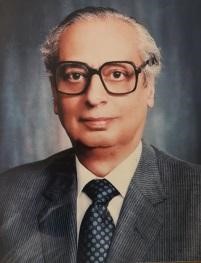
Mr. Riyaz H. Bokhari
Former Auditor-General of Pakistan
02-12-1984 to 02-12-1989
Education:
Mr. Riyaz Husain Bokhari, born on May 12, 1925, earned an Honours degree in Civil Engineering. On September 26, 1954, he went to Canada for nine months of specialised training under the Colombo Plan in Railway Accounting and Mechanical Compilation of Accounts. During this period, he also pursued studies in Advanced Cost Accounting at the McGill University in Montreal. On his way back, he further refined his expertise with six months of additional training in Railway Accounting in the United Kingdom.
His quest for learning took him across Europe when he visited the United Kingdom and West Germany from September 11 to October 18, 1964 on a study tour of the Electricity Industry. Embracing the rapid advancements in technology, he attended the IBM Executive Computer training course in Philadelphia, USA, in December 1965. Later, under the USAID Program, he underwent thirteen weeks of rigorous training in Railroad Financial Management in USA from February 26 to June 4, 1969. He also attended IBM computer training during this period.
Professional Experience and Achievements:
Mr Bokhari’s distinguished career spanned nearly four decades, transitioning from engineering to financial services, and high-level public administration. His journey began in the Military Engineering Service as a Temporary Assistant Engineer Buildings and Roads Branch from June to August 1949. He then joined the West Pakistan Service of Engineers, Class II, as an Assistant Engineer on 27th August, 1949 and served there till March 1950.
His career took a decisive turn on March 18, 1950, when he joined the West Pakistan Railway Accounts Service. He quickly rose through the ranks, holding positions as Junior Accounts Officer and Senior Accounts Officer. In November, 1956, he was elected as an Associate of the Pakistan Institute of Industrial Accountants, Karachi, a testament to his growing expertise in financial management. His appointment as Chief Accountant (Electricity) at the West Pakistan Water and Power Development Authority in 1962 further solidified his reputation in financial oversight.
He gained international recognition for his auditing skills when he was chosen to serve on Pakistan's External Audit Team for the United Nations in New York in 1965 and 1966. He was one of the first officers from the Civil Service of Pakistan to receive specialised training in Computer Operations and Programming from IBM USA. This expertise later on led to his appointment as the head of the Computer Services Bureau-cum-Training Centre in Rawalpindi in 1971.
His ascent within Pakistan Railways continued as he was promoted to Financial Advisor and Chief Accounts Officer in 1969. His strategic financial leadership led to his appointment as Member Finance, Railway Board in 1972, and later as the Chairman, Railways Board. However, his influence extended beyond the railway sector. In 1976, upon his promotion to BS-22, he was appointed Chairman of the Light Engineering Corporation. He later oversaw important industrial and economic policies as the Chairman of the National Fertiliser Corporation of Pakistan and later as Secretary of the Ministry of Industries. On December 2, 1984, the President of Pakistan appointed him the Auditor-General of Pakistan, a role he held for the following five years.
Mr Bokhari was a man of vision and foresight. During his tenure, the office of the Auditor-General was alive with purpose. It was a time of learning, collaboration, and refinement. International experts arrived, methodologies evolved, and a culture of excellence took root.
Under Mr. Bokhari's stewardship, the Accountants-General Conference adopted a forward-looking approach by shifting its emphasis from retrospective evaluations to strategic planning. This landmark decision led to the establishment of specialised working groups in auditing, accounting, and management, setting a structured course for future reforms.
A staunch believer in international benchmarking and cooperation, Mr. Bokhari welcomed a Dutch Evaluation Mission in 1985 to assess Pakistan’s progress in performance auditing. Their report praised the country’s rigorous training mechanisms and well-structured audit guidelines—affirmations that positioned SAI Pakistan as a credible and capable Supreme Audit Institution on the global stage.
Mr. Bokhari also convened the Audit & Accounts Conference, a watershed event that addressed challenges in the timely preparation of accounts, promoted computerisation of payroll and accounting systems, and emphasised training for audit professionals. He successfully enhanced the level and extent of computerisation in the processing of payrolls and maintenance of accounts. His embrace of computer technology, particularly at a time when such concepts were still novel in public institutions, reflects both foresight and adaptability.
Perhaps one of his most enduring contributions was to oversee the completion of 12 volumes of guidelines in Performance Auditing. Remarkably, no other developing country had attempted such extensive documentation of guidelines in this detail. These guides demystified performance evaluation for performance auditors, offering sectoral overviews, key performance indicators, and analytical frameworks in a non-technical language. These guidelines became the bedrock of professional audit practice in Pakistan.
He played a key role in expanding the training portfolio of Pakistan Audit & Accounts Training Institute—an institution that has since evolved into Pakistan Audit and Accounts Academy.
An equally remarkable milestone was the indigenisation of audit training. For the first time, Intensive Training Programme was conducted entirely using local expertise, reflecting the growing self-sufficiency in audit training by Pakistan Audit Department. DAGP had assumed full responsibility for its training programmes after five years of Dutch technical assistance. SAI’s Pakistan's expertise under Mr. Bokhari was internationally recognised at the 1987 Seminar on "Assessing Project Performance" in the Netherlands, where the Pakistani delegation presented one paper and two case studies in two sessions. The same year, DAGP extended training support to the Auditor-General of China—another testament to Pakistan’s growing stature under his leadership.
Under his wise command, Performance Audit Reports earned wide recognition from the Public Accounts Committee (PAC). Furthermore, Performance Evaluation Cell (PEC) undertook rigorous evaluations across various economic sectors. Public enterprises responded positively to audit evaluations, with some organizations implementing recommendations even before formal PAC reviews. This unprecedented responsiveness highlighted the increasing trust in DAGP's professionalism and influence.
Mr. Bokhari understood the power of the written word in shaping minds and institutions. His initiatives in publications were equally impactful. He launched the monthly journal “Audit News & Views”, a platform that gained international acclaim for broadening the understanding of public audit systems. Similarly, “Phoenix”, a publication series initiated under his guidance, served as a bridge between the past and the future, capturing the wisdom of retired officers for the benefit of future public finance managers and auditors. This book received widespread acclaim, with positive reviews from Morning News and Business Recorder.
In the realm of professional accounting and cost management, his legacy is equally towering. He was the longest-serving President of the Institute of Cost and Management Accountants of Pakistan (ICMAP), holding office from 1979 to 1990, and had been a member of the National Council since 1970. Under his visionary leadership, the profession grew at an accelerated pace, with significant initiatives undertaken to expand the Institute’s physical infrastructure in major cities across Pakistan. As a former President of the Institute, he established the Khadija Riaz Bokhari Medal (KRB), named in honour of his wife. His initiative highlighted his deeply personal commitment to education and excellence. It also reflected his appreciation for the role of family and community in shaping public service. Later on, in recognition of his outstanding services, a computer centre was established in this name in 1991 at the Institute’s Karachi campus.
Under his wise leadership, ICMAP played a central role in a historic policy reform: the integration of cost audit provisions into the Companies Ordinance. His tireless advocacy and negotiations with the Finance Division and Corporate Law Authority resulted in the inclusion of Section 258. This provision related to the audit of cost accounts of companies and granted Cost & Management Accountants as well as Chartered Accountants the authority to conduct them.
His commitment to international engagement was unwavering. Mr. Bokhari represented Pakistan at the 3rd Assembly of ASOSAI in Tokyo (1985), welcomed delegations from Canada and Sri Lanka, and hosted an international course on performance evaluation of Public Sector Enterprises in Lahore—the first of its kind—attended by auditors from China and the UAE. These engagements fostered global goodwill and knowledge exchange.
Mr. Bokhari also focused on international collaboration and interacted with the heads of different SAIs for mutual benefit. The Auditor-General of Sri Lanka called on him in December 1986 and discussed matters of mutual interest. Later, Mr. Kenneth M. Dye, Auditor-General of Canada, accompanied by his wife, also visited the Auditor-General of Pakistan in November 1988 to promote mutual understanding and friendship between the two Supreme Audit Institutions. The meetings inter alia reviewed the usefulness and effectiveness of training facilities provided by Canada to PAD officers in comprehensive auditing, exchange of information, and literature on government auditing etc.
After his retirement on February 02, 1989, Mr. Bokhari remained actively involved in professional pursuits. He consistently worked with the Government of Pakistan and the World Bank in an advisory capacity. After a brief illness, he passed away on 29th October, 2023 at the age of 98. Though he has taken his final bow, his legacy lives in the footsteps of his children—Professor Shahid H. Bokhari, Rubina Bokhari, and Sohail Bokhari.
In history, Mr. Riaz H. Bokhari will be remembered as a man of boundless ambition and extraordinary versatility! He was a polymath in the truest sense — a civil engineer by training, a cost accountant by expertise, an IBM-certified technology enthusiast, and the esteemed Auditor-General of Pakistan. He proved that the human mind need not be confined to a single field; it can expand, evolve, and leave an indelible mark across multiple domains. Few have lived a life so diverse, so impactful.